MIT Astronomers Catch a Star Slowly 'Snacking' on a Brown Dwarf 300 Light-Years Away
MIT astronomers have observed, for the first time, a stable transfer of matter from a brown dwarf onto a small red dwarf star 300 light-years away — a slow stellar feast that could continue for hundreds of thousands to billions of years.
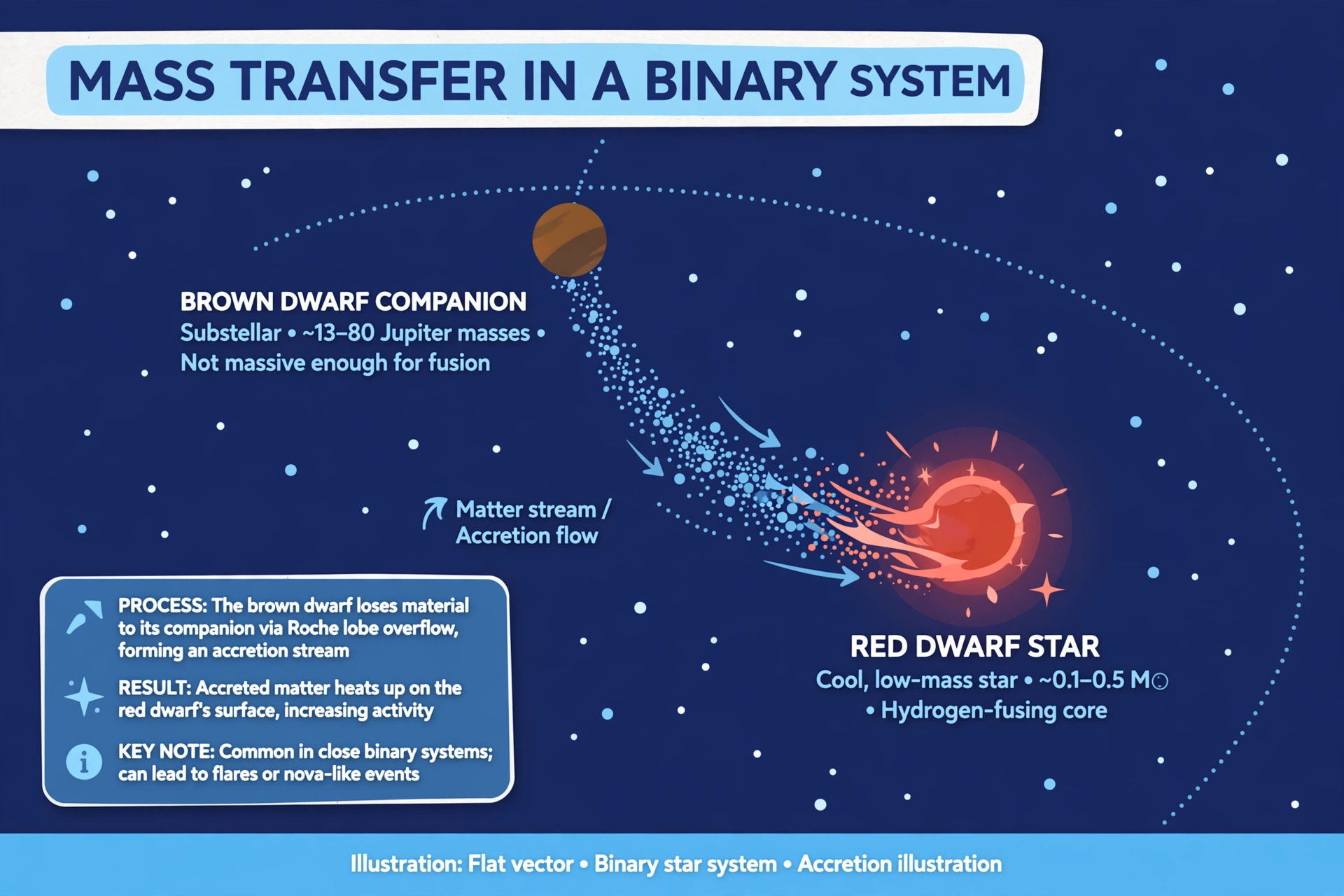
Astronomers at the Massachusetts Institute of Technology announced on October 5 that they had caught a red dwarf star in the act of slowly accreting material from a closely orbiting brown dwarf companion — the first observed case of stable mass transfer between two low-mass objects.
The system, designated ZTF J0440+2325, lies about 300 light-years away and was spotted with the Zwicky Transient Facility at Palomar Observatory. The brown dwarf — roughly 25 times the mass of Jupiter — circles its host star, about 85 Jupiter masses, every 87 minutes, feeding it at a rate of around one hundred-thousandth of Earth's mass per year. The discovery was led by assistant professor Kevin Burdge and graduate student Aaron Householder, with collaborators from Caltech, the University of Hawaii, the Instituto de Astrofisica de Canarias, the Universidad de La Laguna and the Harvard-Smithsonian Center for Astrophysics, and published in the journal Nature Astronomy.
Why it matters
The observation gives astronomers a new window into how the smallest stars and their companions evolve over cosmic timescales — a process in this system that could run for hundreds of thousands to billions of years.
Sources & verification
This story was checked against the sources below before publication. Primary sources are listed first; independent reporting is used to corroborate, never to copy.
Related stories
Kerosene Leak Spreads More Than Two Miles Along the River Taff in South Wales
Kerosene leaked into the River Taff near Taff's Well, South Wales, and has spread about 2.5 miles (4 km) downstream, Natural Resources Wales says. First reported Saturday morning affecting about a mile, the slick grew as NRW investigated the source and deployed absorbent booms. NRW believes up to about 25,000 litres entered the river via an underground surface-water drainage system; the flow was reportedly stopped by fire crews at a GE site on Friday. Residents were told to keep windows and doors shut as fumes smelled like a petrol station. The investigation is ongoing and the situation is developing.
Webb Telescope Reveals Exoplanet's Lopsided Atmosphere in First-of-Its-Kind Map
A team led by Dr Lili Alderson of Cornell University and the University of Bristol has used the James Webb Space Telescope to discover that the atmosphere of the hot Jupiter WASP-17b is asymmetrical — the first direct observational evidence of an exoplanet atmosphere's uneven 3D shape. The evening limb extends about 1.8 times farther into space than the morning limb and is roughly 660°C hotter, according to a study published in Nature Astronomy on October 14, 2026.
NASA's Roman Space Telescope Sharpens Focus to Nearly 30% Better Than Predicted
During in-space commissioning, the Nancy Grace Roman Space Telescope's main instrument measured nearly 30% sharper than its design requirement after a secondary-mirror adjustment of about one-sixteenth the width of a human hair, NASA reported. First public images are expected in early 2027.