Princeton Physicists Propose a 'Heat First' Shortcut to Fusion Ignition
Physicists at the U.S. Department of Energy's Princeton Plasma Physics Laboratory have published a theoretical framework suggesting a more energy-efficient path to fusion ignition: heat the plasma first, then increase its density — reversing the conventional order.
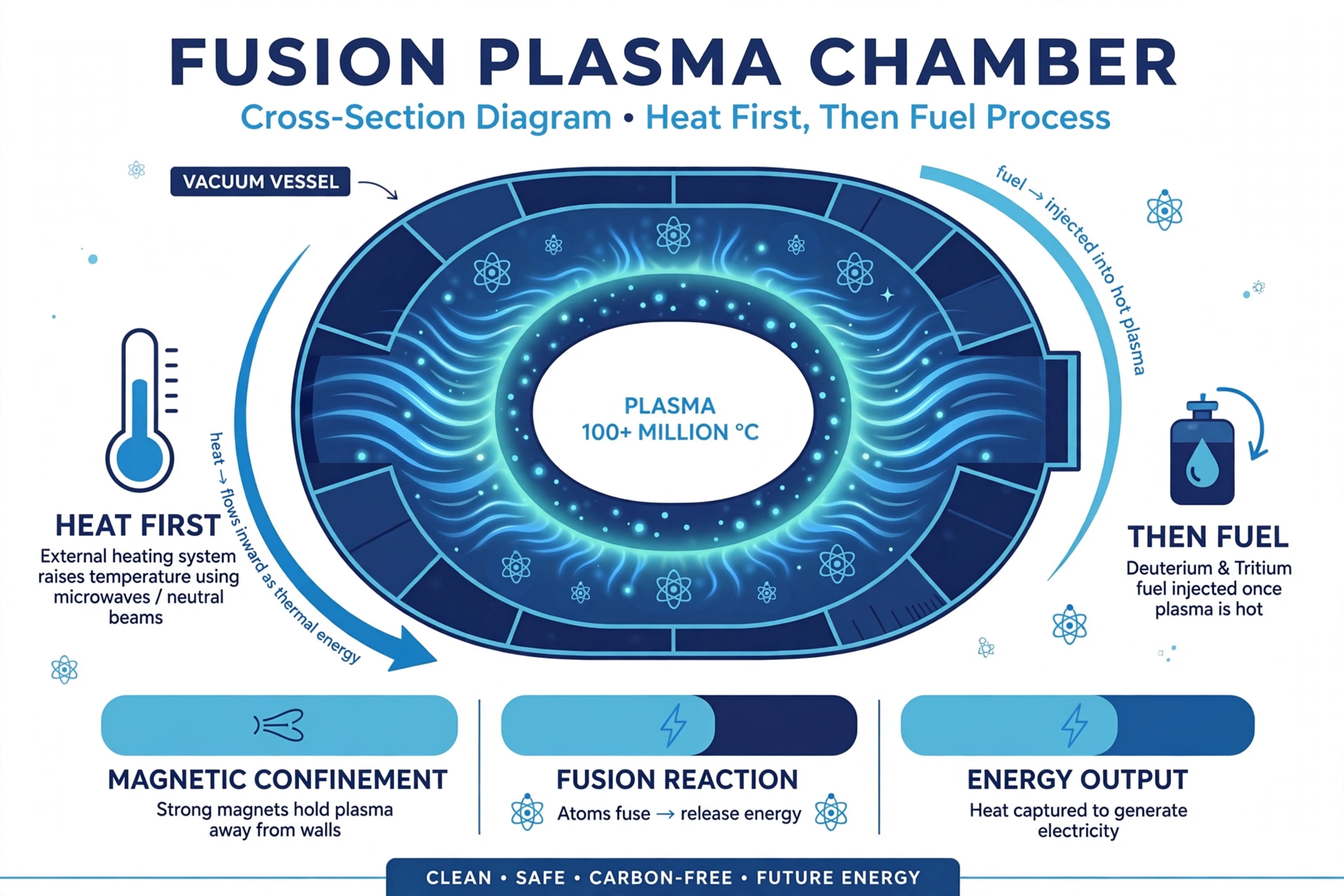
Researchers at the Princeton Plasma Physics Laboratory (PPPL) have proposed a new route toward fusion ignition in a paper published in the journal Physical Review Letters, arguing that heating plasma before raising its density could reach ignition more efficiently than the traditional density-first approach.
The team — Luis Delgado-Aparicio, Masayuki Ono and Jonathan Menard — reformulated the Lawson criterion, the benchmark for fusion ignition set in the 1950s. Their analysis identifies a 'Cordey saddle' in the parameter space: pushing through it by heating first and adding fuel second lowers the energy required. The study also found that trace tungsten impurities — just one part in 10,000 — from reactor wall materials can roughly double the pressure needed for ignition, while the same loss physics acts as a natural safeguard against thermal runaway.
A roadmap, not a reactor
The work is explicitly theoretical, built on calculations rather than experiments; the team plans computer simulations — 'digital experiments' — as the next step. It offers a roadmap for future fusion experiments, not a demonstration of net energy gain.
Sources & verification
This story was checked against the sources below before publication. Primary sources are listed first; independent reporting is used to corroborate, never to copy.
Related stories
Kerosene Leak Spreads More Than Two Miles Along the River Taff in South Wales
Kerosene leaked into the River Taff near Taff's Well, South Wales, and has spread about 2.5 miles (4 km) downstream, Natural Resources Wales says. First reported Saturday morning affecting about a mile, the slick grew as NRW investigated the source and deployed absorbent booms. NRW believes up to about 25,000 litres entered the river via an underground surface-water drainage system; the flow was reportedly stopped by fire crews at a GE site on Friday. Residents were told to keep windows and doors shut as fumes smelled like a petrol station. The investigation is ongoing and the situation is developing.
Webb Telescope Reveals Exoplanet's Lopsided Atmosphere in First-of-Its-Kind Map
A team led by Dr Lili Alderson of Cornell University and the University of Bristol has used the James Webb Space Telescope to discover that the atmosphere of the hot Jupiter WASP-17b is asymmetrical — the first direct observational evidence of an exoplanet atmosphere's uneven 3D shape. The evening limb extends about 1.8 times farther into space than the morning limb and is roughly 660°C hotter, according to a study published in Nature Astronomy on October 14, 2026.
NASA's Roman Space Telescope Sharpens Focus to Nearly 30% Better Than Predicted
During in-space commissioning, the Nancy Grace Roman Space Telescope's main instrument measured nearly 30% sharper than its design requirement after a secondary-mirror adjustment of about one-sixteenth the width of a human hair, NASA reported. First public images are expected in early 2027.